
Stop Thinking Before You Start: How AI Flipped the Order of Work
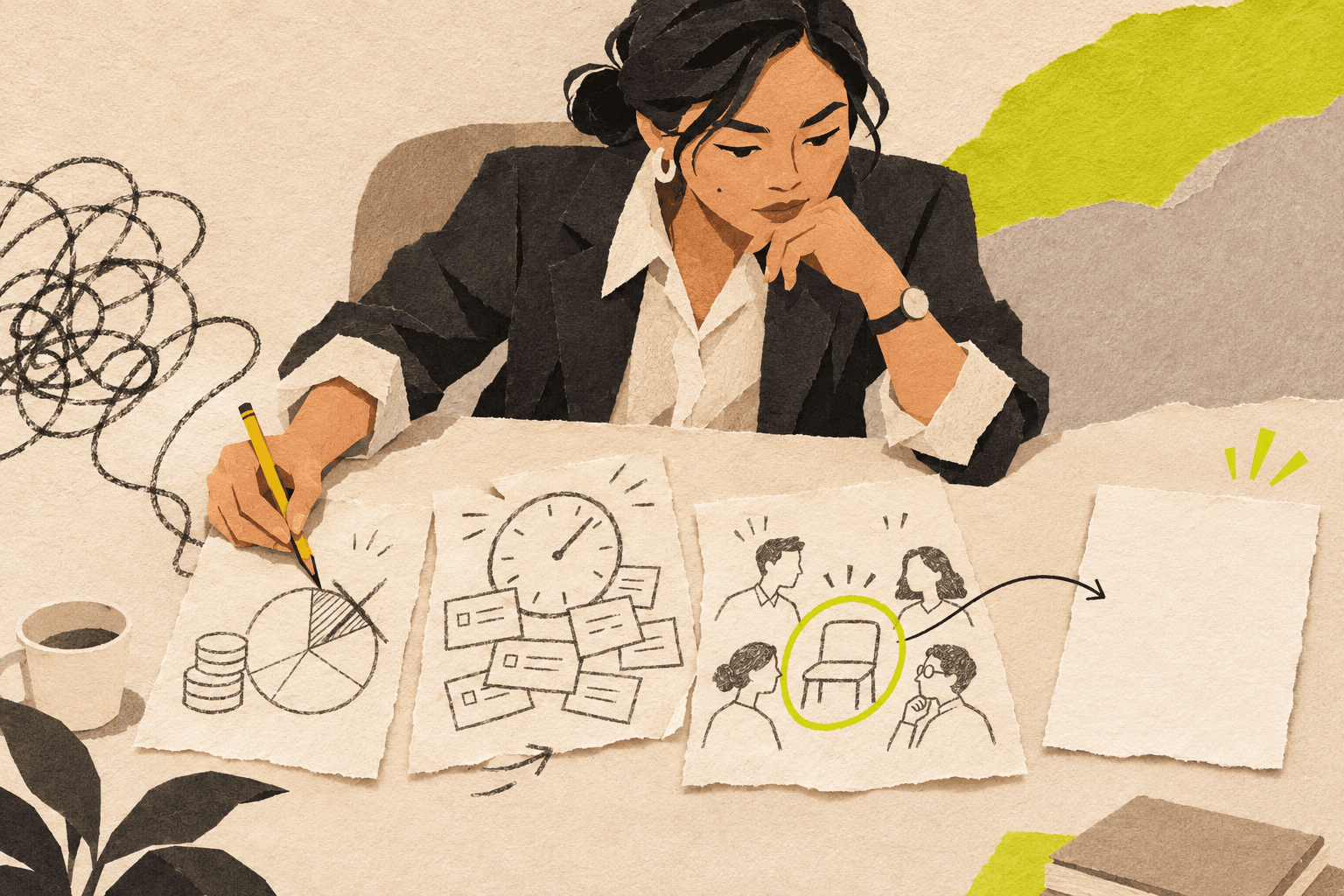
Short answer: for most of working history you needed to know what the problem was before you could start on it, because a first attempt took an hour and a wrong one wasted the hour. AI dropped the price of a first attempt to about a minute. That flips the order.
You can now start the moment you're stuck, let AI offer a few readings of what might be going on, and find out what you actually mean by reacting to them. "No, that's not it" is usually the moment the real problem shows up.
Clarity used to be the input to the work. Now it can be the first thing the work produces. One rule helps limit fixation: ask for three readings, never one, and throw all three away once you know what you mean.
You still think. The start just moves one step earlier
The title says stop thinking before you start. It doesn't say stop thinking. The thinking still happens, and there is usually more of it, because now you have something concrete to think about. What changes is the order:
| Step | Old order | New order |
|---|---|---|
| 1 | Think until you're clear | Start with a rough ask |
| 2 | Start the work | React: "no, that's not it" |
| 3 | Get clear | |
| 4 | Start the work |
Getting clear stays where it was: before you commit to a solution, and before anything goes to another person. The only thing that moves is the first step.
You do your thinking with something in front of you instead of a blank page.
The task with no first step
Every team has a task that sits in "later" for a week. "Look into why people aren't using the new system." "Think about how we approach the renewal." "Sort out onboarding." Nobody avoids it because it is hard. They avoid it because there is nothing to start on yet.
You can't write the brief, because you can't say what the problem is, and you can't say what the problem is until you've done some of the work.
Speak, Structure, Check, Reuse covered the case where you know the situation and can't get it into words. This post is about the harder case: you don't yet know what the situation is.
What changed: a wrong first attempt is now nearly free
Before AI, drafting came after thinking for an economic reason. A first draft of a proposal, a plan or an analysis took an hour or more. If you drafted the wrong thing, you lost the hour. So the sensible order was to think until you were clear, then draft once.
Harvard Business School professor Stefan Thomke studied what happens when technology collapses the cost of trying something. In Experimentation Matters (2003) he showed that when computer simulation made engineering tests cheap and fast, the efficient process moved from planning everything up front to running many early, cheap tests, because information found early is worth far more than information found late [1]. Engineers got that shift decades ago. Anyone who writes for a living just got it.
The capability itself is old. Senior people always had it, in rationed form: a chief of staff, a junior analyst, a patient boss they could hand a half-formed problem to and say "help me work out what this is." Writers had freewriting. Designers had sketches. What is new is that it is on demand, private, nearly free and answers in seconds. What senior people always had, someone to hand a half-formed problem to, every employee now has.
Why reacting beats specifying
The philosopher Donald Schön spent years watching how architects, therapists, planners and managers actually work. In The Reflective Practitioner (1983) he argued that in messy, one-off situations, professionals don't receive a defined problem and then solve it [2]. Setting the problem is part of the work. They make a move, see how the situation responds, and reframe. The clarity comes through the moves.
Schön called this reflection-in-action.
AI changes the speed of that loop, not its shape:
| In Schön's terms | Before AI | With AI |
|---|---|---|
| Make a move | Draft something, sketch an option | A voice dump or a rough ask, one minute |
| See how the situation responds | Wait for a colleague to read it | Three readings back in seconds |
| Reframe | In a meeting, in front of people | In private, as many times as you need |
The useful moment is the reaction. It is usually far easier to say what is wrong with a draft than to describe the right one from scratch. "No, that's not it, it's more like..." is the sentence that tells you what the problem is. Every wrong reading narrows down the right one.
The same thing happens when a manager builds a rough version of the dashboard they want: the most valuable output is often the clarity, not the tool.
"I'm not clear on the problem" means four different things
This is the part most advice about "AI as a thinking partner" skips. The phrase covers four situations, and starting before you're clear only works for three of them.
| What people say | What is actually missing | Does starting first work? | What to ask AI for |
|---|---|---|---|
| "I don't know how to prompt" | Words for a situation they already understand | Yes | A brief from a voice dump (Speak, Structure, Check, Reuse) |
| "I don't know where to start" | An order. Too many pieces at once | Yes | Sort the pile and name the first step |
| "I don't know what the real problem is" | A frame: is this a symptom or the cause, which question is worth answering | Yes | Three readings of the problem to react to |
| "I don't know what they want" | Facts held by someone else: the boss's real expectation, the customer's budget | No | The questions to ask that person. Never the answer |
The fourth row is where this goes wrong in real offices. AI will fill a gap in someone else's head with a plausible guess. A fluent draft built on a guessed expectation looks finished, so it gets sent.
When the missing piece belongs to another person, the right output is a better question for that person.
The trap: the first draft becomes your framing
Starting early has a known failure. In a 1991 study, designers who were shown an example solution before they began kept reusing its features, including features that were deliberately flawed [3]. Researchers call it design fixation.
A single AI draft can create a similar risk. You think you're discovering the problem, and you're adopting the AI's version of it.
A 2010 Stanford study points to the fix. Novice designers making web ads either produced several versions and got feedback on them together, or got feedback after each one. The several-at-once group made ads that did better on click-through and expert ratings, were more varied, and left the designers more confident [4].
So the rule is: ask for three readings, never one. React to all three. Then throw them away and write the brief from what you now know.
The readings were tools for thinking, not drafts of the answer.
The prompt
Paste this, then talk through what's bothering you:
I'm not sure what the real problem is yet. I'm going to talk through what's bothering me, in no order. Don't solve anything. Give me three different readings of what the problem might be, two sentences each, and what would have to be true for each one. Then ask me the one question that would tell us which reading is right. Label all three as guesses.
Then react out loud: "Not the first one. Closer to the second, but it's less about the budget and more about who owns it." Answer its question. When you can say in one sentence what you're solving, run the starter prompt from Speak, Structure, Check, Reuse on what you now know and carry on. We teach both prompts in our in-house AI training programmes.
If the missing piece turns out to be something only another person knows, switch: "Give me the three questions I should ask my manager to find out."
Where it fits in Speak, Structure, Check, Reuse
This is not a second method. Speak, Structure, Check, Reuse assumed you already understand your situation and need it in words. This adds a second way in.
You don't need to know the problem to Speak. When things are unclear, Structure asks for three readings instead of one brief. Check is where you find out what you meant. After that, the normal flow carries on.
How to tell if it's working
The obvious measure is wrong. Count how much people produce and this idea will look like a win while it inflates output on the wrong problem: more decks, same confusion.
A draft that exists is not progress. A problem you can state in one sentence is.
Use these as discussion prompts, not validated performance thresholds.
| Measure | Healthy | Warning sign |
|---|---|---|
| Time from a fuzzy task arriving to a brief you'd sign off on | Same day | Still "thinking about it" a week later |
| Fuzzy tasks started on the day they arrive | Going up | Flat |
| Rethinks before the brief | One to three | Zero: the first framing was accepted as is |
The third row is the one to watch. Zero rethinks is a reason to check whether the first framing was accepted too readily, not proof of fixation.
What this does and does not show
The research supports the parts: professionals in messy situations define the problem by acting on it (Schön), cheap experiments change the best order of work (Thomke), a single example narrows thinking (Jansson and Smith), and several options before feedback beat one at a time (Dow and colleagues). None of it tested AI-assisted problem framing at work.
What would prove this wrong: people who start with AI's readings settle on its first framing and end up with worse briefs than people who define the problem first. The scorecard above is how we are watching for that.
When a task has no first step, stop waiting to get clear. Ask for three readings, say which one is wrong, and start from there.
References
- Thomke, S. H. (2003). Experimentation Matters: Unlocking the Potential of New Technologies for Innovation. Harvard Business School Press.
- Schön, D. A. (1983). The Reflective Practitioner: How Professionals Think in Action. Basic Books.
- Jansson, D. G. and Smith, S. M. (1991). Design Fixation. Design Studies, 12(1), 3-11.
- Dow, S. P., Glassco, A., Kass, J., Schwarz, M., Schwartz, D. L. and Klemmer, S. R. (2010). Parallel Prototyping Leads to Better Design Results, More Divergence, and Increased Self-Efficacy. ACM Transactions on Computer-Human Interaction, 17(4), Article 18.