
Why We Teach Voice Dictation Before Prompting: The Speak, Structure, Check, Reuse Method

Short answer: when someone says "I don't know how to prompt", what they usually lack is a quick way to get what they already know about a situation out of their head and into a form AI can use. We teach that first, with voice dictation, in four steps: Speak through one real situation, let AI Structure it into a brief, Check the brief for errors, then Reuse it to produce the work. Speaking gets the context out fast. The check keeps it accurate. Reuse is where it pays.
The hidden work before the first prompt
Participants in our AI training classes know their work. Ask what is going on and they will tell you in two minutes: the customer changed their mind, a colleague made a promise, the deadline moved, and the obvious fix will not work because of something that happened last month.
Then they face the empty chat box and freeze.
Writing a good request means doing four jobs at once: recall the situation, decide what matters, phrase it professionally, and say what you want back. Most people either give up, or shrink the request to "write a proposal" and lose every detail that would have changed the answer. Then they decide AI is generic.
The philosopher Michael Polanyi named the underlying problem in one line: we know more than we can tell [1]. Experienced people carry context in their heads, not in sentences. A prompt template does not fix that, because the template still needs the context to fill it.
Research on first-time prompt writers points the same way. A CHI 2023 study found that being able to write plain language did not make prompt design easy: participants without an AI background struggled to develop and evaluate their prompts systematically [2].
Why speak first
A voice dump separates getting the material out from polishing it. You can pause, repeat yourself, correct a detail and add "actually, one more thing". Nobody grades the transcript.
Writing researchers Linda Flower and John Hayes described writing as three processes competing for the same limited attention: planning, turning thoughts into sentences, and reviewing [3]. A blank chat box asks for all three at once. A voice dump asks for one: say what happened. AI does the first pass of organising. You review afterwards, when there is something to review.
Speed helps too. In a Stanford-led lab study, speech input on a phone ran at about 153 words per minute in English against 52 for the touchscreen keyboard, with a similar gap in Mandarin, although speech left slightly more uncorrected errors [4]. That study measured short-message transcription, not business writing, so read it as "speaking is cheap", not as a productivity figure.
Speed is the smaller benefit. The bigger one is what comes out when people talk: what the customer already rejected, what was promised, which colleague needs reassurance, what nobody can confirm yet. Those details turn a generic answer into a useful one, and they are the first to disappear when people type.
The method: Speak, Structure, Check, Reuse
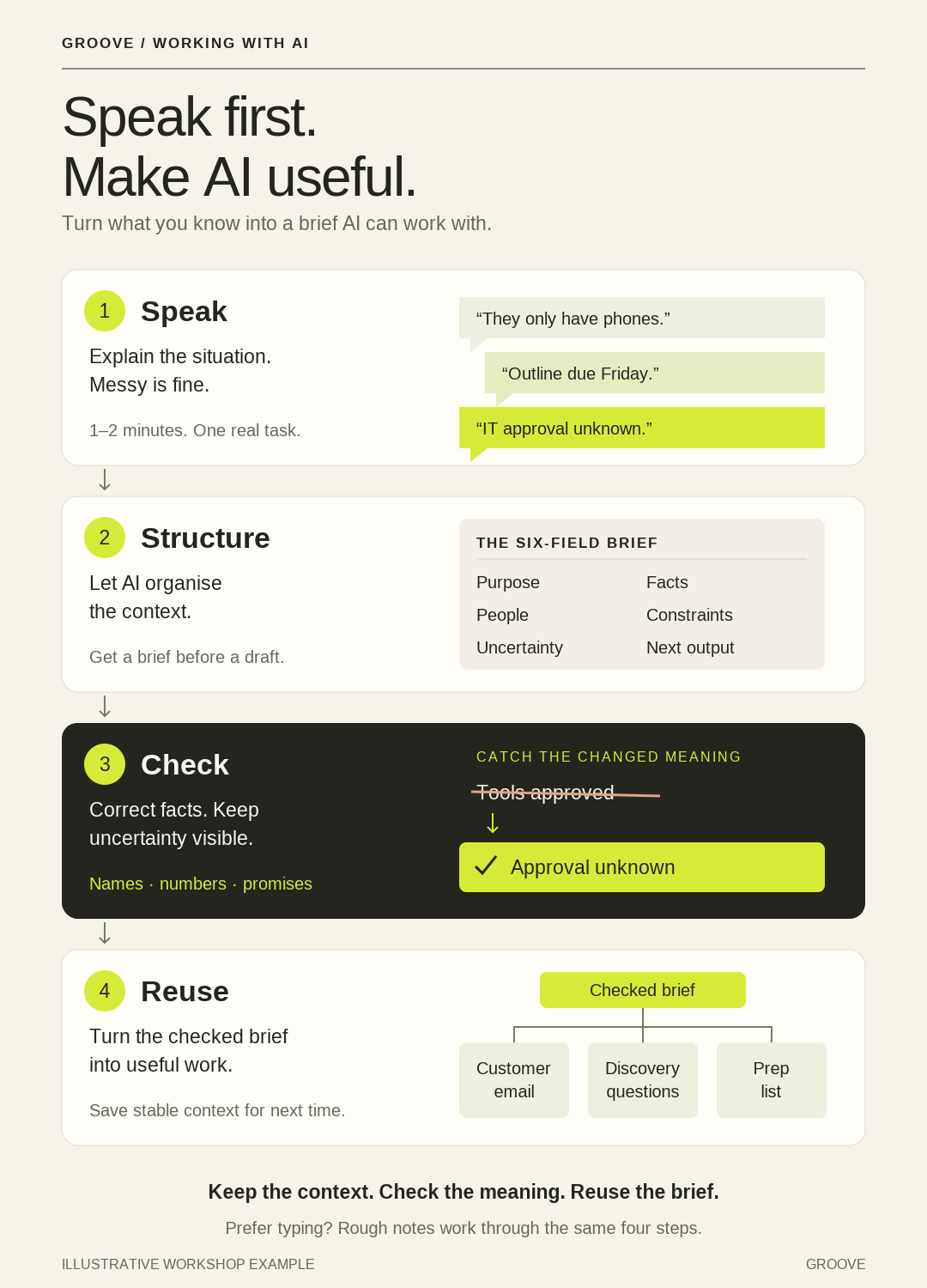
Download the infographic (SVG)
| Step | What you do | What you have at the end |
|---|---|---|
| 1. Speak | Explain one real situation out loud for one to two minutes: what happened, what matters, what is uncertain, what you want help with. | Raw material that holds the context only you have. |
| 2. Structure | Ask AI to organise it into a brief and point out what is missing, before it writes anything. | A short brief you can inspect. |
| 3. Check | Correct names, numbers, dates, priorities and commitments. Verify anything consequential against its source. | A brief that says what is actually true. |
| 4. Reuse | Turn the checked brief into the output you need. Keep the stable parts for next time. | Useful work, plus context you can use again. |
Learners have used it to brief a six-hour virtual workshop, explain a corporate leasing process as an infographic, plan a conference trip and draft a healthcare awareness poster. The situations differ. The four steps do not.
What a good brief contains
Six fields. You do not need to say them out loud. AI applies them afterwards.
- Purpose: what you are trying to achieve
- Facts: what happened and what is known
- People: who is involved and who will read the output
- Constraints: deadlines, preferences and promises already made
- Uncertainty: what is unclear or unconfirmed
- Next output: the email, plan, table or decision you need
A raw transcript has repetition and wrong turns. The brief keeps the useful part and drops the rest. Engineering guidance on AI context makes the same argument: more context is not automatically better, the useful part has to be selected [5].
Why the Check step is not optional
Fluent text gets believed. Human factors research calls this automation bias: when a system gives a confident answer, people check it less, even when they know it can be wrong [6]. A tidy AI summary is exactly that kind of answer.
So we teach learners to hunt for two specific failures:
- Upgraded commitments. "We could deliver on Friday" quietly becomes "we promised delivery on Friday".
- Interpretations turned into facts. "I think the customer is unhappy" becomes "the customer is unhappy".
Either one, sent to a customer, costs more than the time dictation saved.
Check does a second job too. Reading the brief is often when people find out what they actually meant. "No, that's not it, it's more like..." can be the most useful sentence in the whole exercise.
Reuse on purpose
Keep stable context (your role, recurring responsibilities, usual audiences, preferred tone) separate from task details. Paste the checked brief into the next task, or save it in a reference document or your tool's project instructions. Dictation does not make AI remember anything. Memory depends on the tool and its settings.
The starter prompt
Save this and paste it before you start speaking:
I am going to dictate a messy explanation of a real situation. Treat it as raw notes.
First, organise it into: my purpose; the facts; the people involved and who will read the output; constraints, preferences and commitments; what is uncertain or missing; and the output I want.
Keep my meaning. Separate facts from my interpretations. Flag unclear names, dates, numbers and contradictions. Do not invent missing details.
Show me the brief. Ask up to three questions, only if the answers would change your response. Wait for me to confirm or correct it before drafting anything.
Then correct it and continue: "The deadline is Thursday, not Friday. The rest is right. Now write a short reply to the customer and an internal action list."
A worked example
Here is a typical dictation after a sales call (an illustration, not a real client):
"Just finished the customer call. They want a workshop next month. HR asked about attendance and certificates, but the sales manager kept coming back to follow-ups. Some of their people only have phones. I said I'd send an outline by Friday, but I don't know which AI tools their IT allows. I don't want to promise something they can't use."
Typed, this usually becomes "write a workshop proposal". Structured, it shows five separate requirements: an admin need (attendance and certificates), a sales goal (follow-ups), a device constraint (phones), an unknown (approved tools) and a promise already made (an outline by Friday). AI can now ask the right question first ("is Friday's outline provisional, or a quote?"), and the same checked brief produces the customer reply, the discovery questions and the internal prep list.
Where it fits in an AI rollout
Most AI rollouts teach two things: how to ask AI questions, and later, how to connect it to email, files and systems. The step in between gets skipped: giving AI the context that lives only in people's heads. Connected tools supply records. They cannot tell AI which relationship is delicate, which option already failed, or which trade-off matters.
It gets skipped for an ordinary reason. Demos start with a finished prompt. By the time the trainer types it, the hard part (choosing the facts, naming the goal) is already done, out of sight. Learners copy the prompt and still face the blank box with their own messy situation. Economists studying expert judgement call this the curse of knowledge: once you know something, it is hard to imagine not knowing it [7].
Voice is one route, not the only one. Some people think better in writing. Open offices, noise and confidential material make speaking a bad idea. The underlying skill is getting context out of your head, and rough typed notes run through the same four steps work too.
How to teach it and measure it
Once licences and a one-line data rule are in place, give each learner one real, low-stakes task. They speak for one or two minutes, inspect the structured brief, correct it and produce one useful output. Then name the next occasion to use it: after a customer meeting, before a weekly update, when tasks pile up at the end of the day. Plans phrased as "when X happens, I will do Y" have a strong record in behaviour research for closing the gap between intending and doing [8].
Measure the return, not the activity:
| Measure | What it tells you |
|---|---|
| Can the person start without help? | Whether the habit transferred |
| Time to a useful, reviewed result (speaking, checking and editing included) | Whether it actually saves effort |
| Material errors caught at the Check step | Whether people are checking, and what AI gets wrong |
| Was the output used for the task? | Whether it was useful, not just fluent |
| Voluntary reuse within seven days | Whether it is becoming a habit |
Dictated word count shows activity. It cannot show that the context was right or the output was used.
The adoption logic underneath is one of the oldest findings in technology research: people keep using tools they find easy and useful [9]. Speaking makes the start easy. Real context makes the result useful. Checking keeps it trustworthy enough to use again.
Your team already knows how to explain their work. Start there.
What this does and does not show
The classroom uses above are demonstrations and participant reports from our training, not a controlled study. The research supports individual parts of the method: speech is fast, writing overloads attention, fluent output gets over-trusted, specific plans help follow-through. None of it tested this exact workflow. The scorecard above is how we are measuring it.
Continue the series: Stop Thinking Before You Start: How AI Flipped the Order of Work.
References
- Polanyi, M. (1966). The Tacit Dimension. University of Chicago Press.
- Zamfirescu-Pereira, J. D., Wong, R. Y., Hartmann, B. and Yang, Q. (2023). Why Johnny Can't Prompt: How Non-AI Experts Try (and Fail) to Design LLM Prompts. Proceedings of CHI 2023.
- Flower, L. and Hayes, J. R. (1981). A Cognitive Process Theory of Writing. College Composition and Communication, 32(4).
- Ruan, S., Wobbrock, J. O., Liou, K., Ng, A. and Landay, J. A. (2017). Comparing Speech and Keyboard Text Entry for Short Messages in Two Languages on Touchscreen Phones. Proceedings of the ACM on Interactive, Mobile, Wearable and Ubiquitous Technologies, 1(4). arXiv:1608.07323
- Anthropic (2025). Effective context engineering for AI agents.
- Parasuraman, R. and Manzey, D. H. (2010). Complacency and Bias in Human Use of Automation: An Attentional Integration. Human Factors, 52(3).
- Camerer, C., Loewenstein, G. and Weber, M. (1989). The Curse of Knowledge in Economic Settings: An Experimental Analysis. Journal of Political Economy, 97(5).
- Gollwitzer, P. M. and Sheeran, P. (2006). Implementation Intentions and Goal Achievement: A Meta-Analysis of Effects and Processes. Advances in Experimental Social Psychology, 38.
- Davis, F. D. (1989). Perceived Usefulness, Perceived Ease of Use, and User Acceptance of Information Technology. MIS Quarterly, 13(3).