
Why AI Changed the Career Game
Originally posted on cheeann.com, Chee Ann's personal site.
Every few weeks someone asks me what AI means for their role. Or their industry. Or what work will look like in three years.
I always struggle with this question, and for a long time the struggle bothered me. This is literally my job. I should have an answer.
I finally worked out what the struggle is. The question asks for a prediction, and a prediction is the wrong deliverable. There's a better framing underneath, one I keep reaching for mid-conversation and failing to say out loud in under a minute. So I'm sitting down and writing it out properly.
Here's the shape of it. AI's real effect on your career sits one level below "what happens to my role." It changed which strategy for deciding wins.
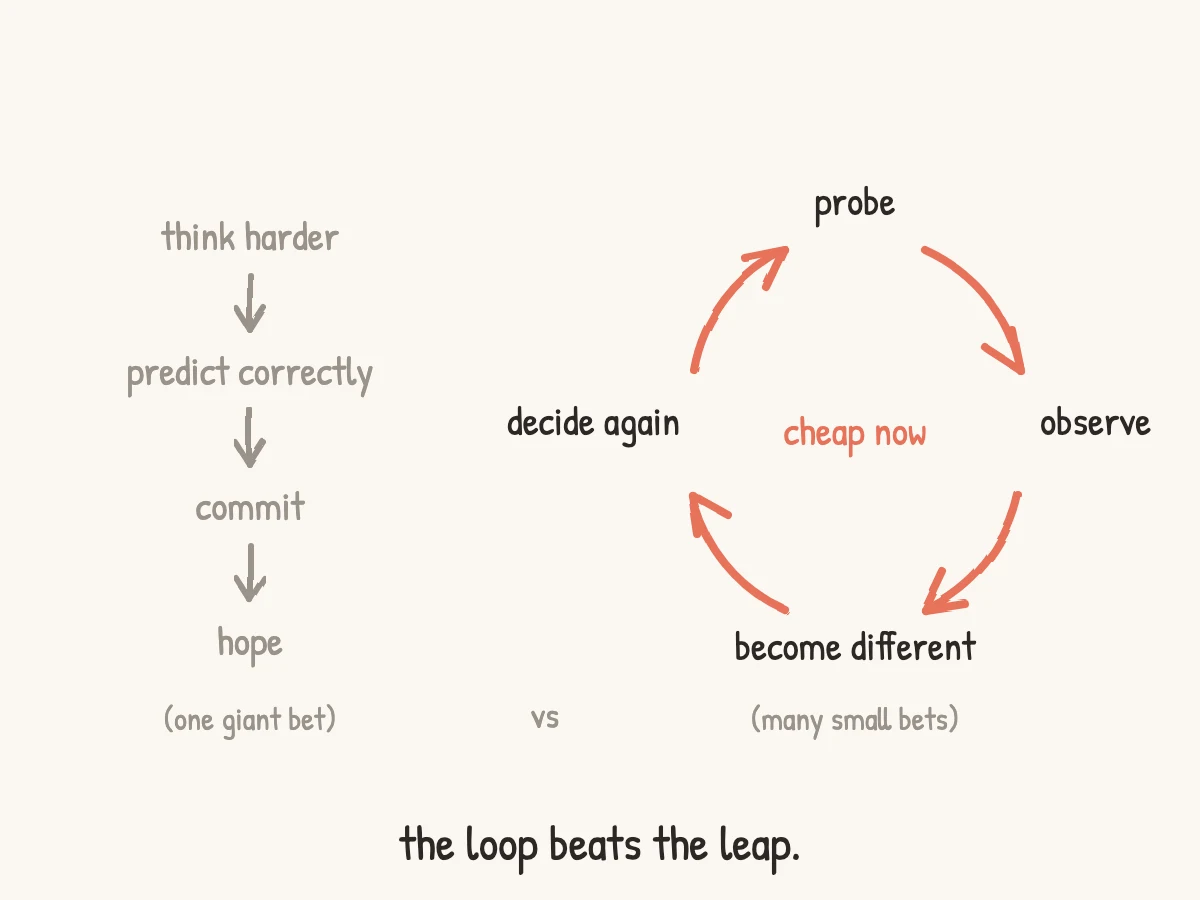
The old way of making a big decision goes: think harder, predict correctly, commit.
There's another way: probe cheaply, observe, become different, decide again.
The nerd version
I have a CS degree and I'm going to use it for two minutes. Bear with me, the formulas are doing real work here.
At any point in time, you are a state:
s(t) = (skills, reputation, cash, network, audience, evidence, preferences)
You take an action:
a(t) = launch an offer, publish, pitch, prototype, teach
And the thing that actually matters is this one:
P( s(t+1) | s(t), a(t) )
Read it out loud: the probability of who you are next, given who you are now and what you do now. Your action doesn't just produce an outcome. It shifts the whole distribution of people you might become.
This is the part the productivity framing of AI misses. "AI helps me execute faster" treats the action as a task to finish. The interesting term in the equation is the next state.
The "become different" part
That's the bit I kept missing. After you run a small real-world experiment, you're not just you plus one data point. After ten videos or three pitches, the next version of you might have:
- three people asking to buy something
- evidence that nobody cares
- a new collaborator
- a reusable artifact
- twenty conversations with real customers
- a changed preference: "oh, I actually love doing this"
- or the opposite: "I absolutely do not want this business"
The person making decision two is not the person who made decision one.
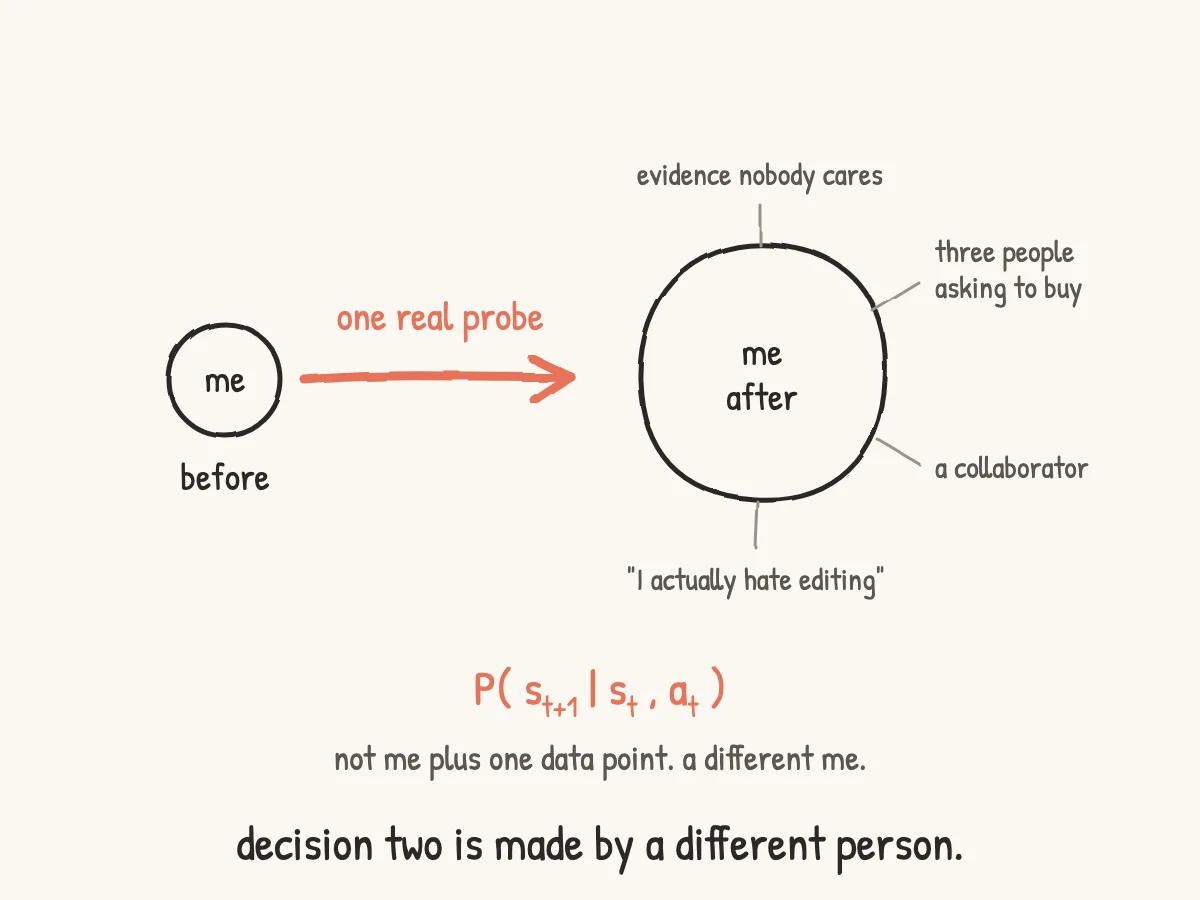
Which is why trying to solve your whole career with one giant decision today is the wrong math. You're planning for a future self whose preferences you can't see from here. She doesn't exist yet. Your next action is part of what creates her.
What actually changed
Sampling a possible future used to be expensive.
"Should I launch my own product line" used to cost a brand designer, a packaging run, a manufacturer's minimum order, and a year of savings before reality said anything back. That's a brutal price for one data point.
Now a tiny version of that future costs a weekend. A real-looking brand, product copy, a preorder page, ten conversations with people who already sell to that customer. Fulfil the first orders by hand if you have to. You get to live inside a slice of the future before buying the whole thing.
Same with "should I make videos." That question doesn't need a 30-page analysis anymore. Make ten videos. The question quietly changes from "will I succeed at this," which is unanswerable, to "what will I learn after publishing ten of these," which answers itself.
A 30-page career analysis is a very sophisticated way of not making ten videos.
Scoring an action
The default scoring rule most of us run is something like: pick the action with the biggest immediate payoff. In notation:
choose a to maximise E[ payoff ]
The rule I actually use now has three more terms:
value of an action = payoff + learning + option value − cost
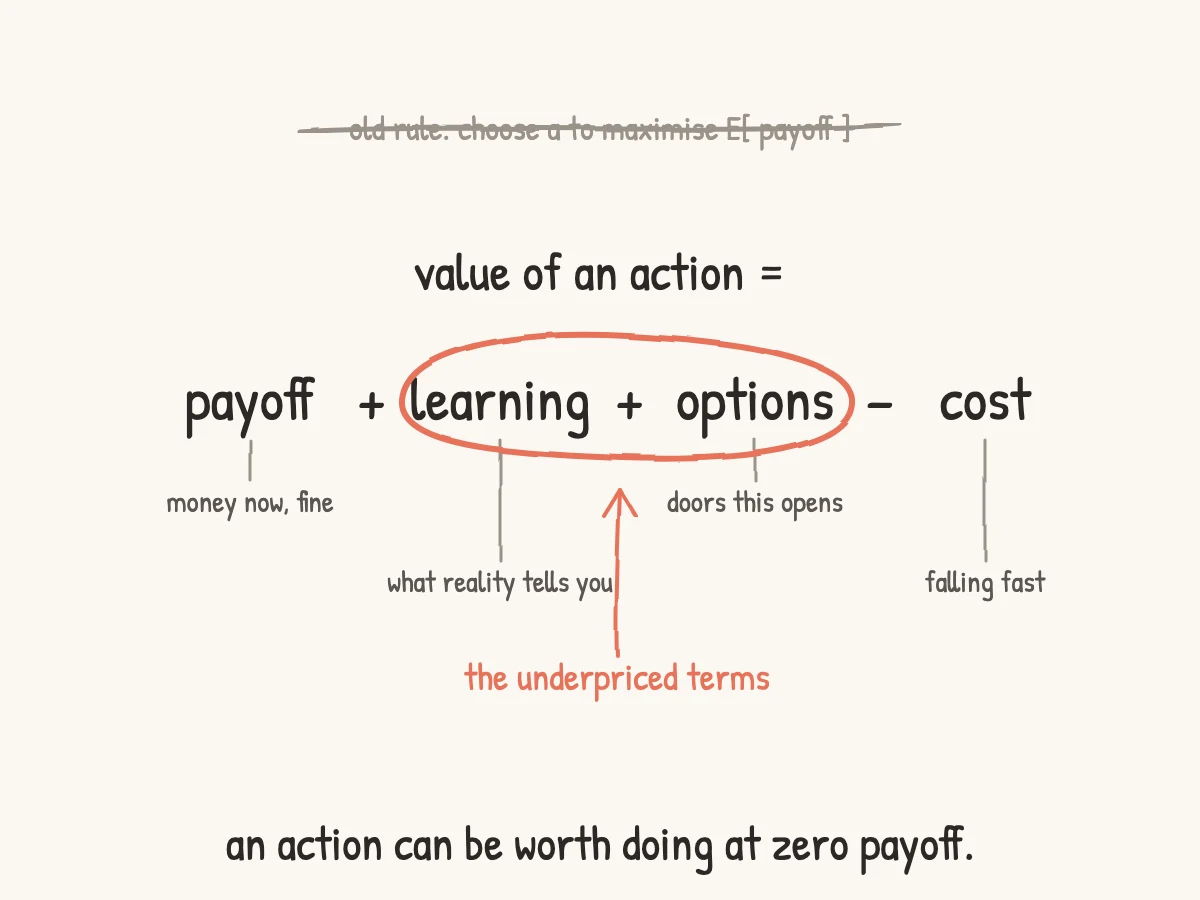
An action can be worth doing at zero immediate payoff, because it collapses uncertainty or opens doors. A probe that "fails" still pays out through the learning term. And the cost term is the one AI keeps shrinking, which quietly re-prices every experiment you ever talked yourself out of.
Small example. I put one new framework slide into a recent workshop, just to watch the room. Whether people photograph the slide, whether managers start applying it to their own processes unprompted, that's all signal. A slide can become a workshop. A workshop can become an audit. An audit can become a methodology. I couldn't have predicted that chain from my desk, and I didn't have to. The first action creates the next option.
Running it on my own question
I'm not exempt from any of this. For about a year I've been trying to answer "what is my positioning" by thinking harder about it. AI trainer? Implementation consultant? Work redesign person? I have notes. So many notes.
The question isn't answerable from a chair. The information doesn't exist yet. No amount of wordsmithing produces it.
So instead of picking one, I'm running all three. One framing per conversation: training teams, deploying systems, redesigning how work splits between humans and AI. Real pitches, real one-pagers.
Notice what I'm not doing: asking people which framing sounds better. Asking for opinions produces polite answers, and polite answers are weak evidence at best, noise most of the time. Using the framings in live conversations and watching which one makes a decision maker lean in and say "can you do this for us" produces strong evidence.
Maintaining three serious versions of a pitch used to take weeks of deck-making, which is why nobody did it. With an agent it's an afternoon each. That's the change: I can afford to keep three hypotheses about my own business alive at the same time and let the market vote with its follow-up questions.
Three upgrades to the probe
Probes got cheaper, so I can run more of them. Obvious.
Probes got higher fidelity, which I think matters more. A cheap test used to look cheap, and then a failure told you nothing. Did they reject the idea, or the ugly landing page? Now a weekend probe can look like a real product, so a "no" finally means something.
And the update loop got faster. After a batch of pitches I hand the transcripts to Claude Code and ask: what did we believe going in, what survived contact, what surprised us, what should the next probe change.
So the whole cycle runs: hypothesis → generate → act → observe → update. AI helps with every step except one.
That's the rule I'm strict about: the AI never manufactures the evidence. It can design the experiment, build it, instrument it, analyse it. Reality provides the reward. The moment you let a model tell you "this idea rates 8.4/10," you're back to intellectual entertainment, just at machine speed.
The question I ask now
For uncertain decisions I've stopped asking "what should I choose."
The better question: what is the cheapest action that makes the next decision easier?
Bonus points if the downside is reversible and the probe leaves something behind even when it fails. An artifact, a relationship, a case study, a sharper sentence about what I do.
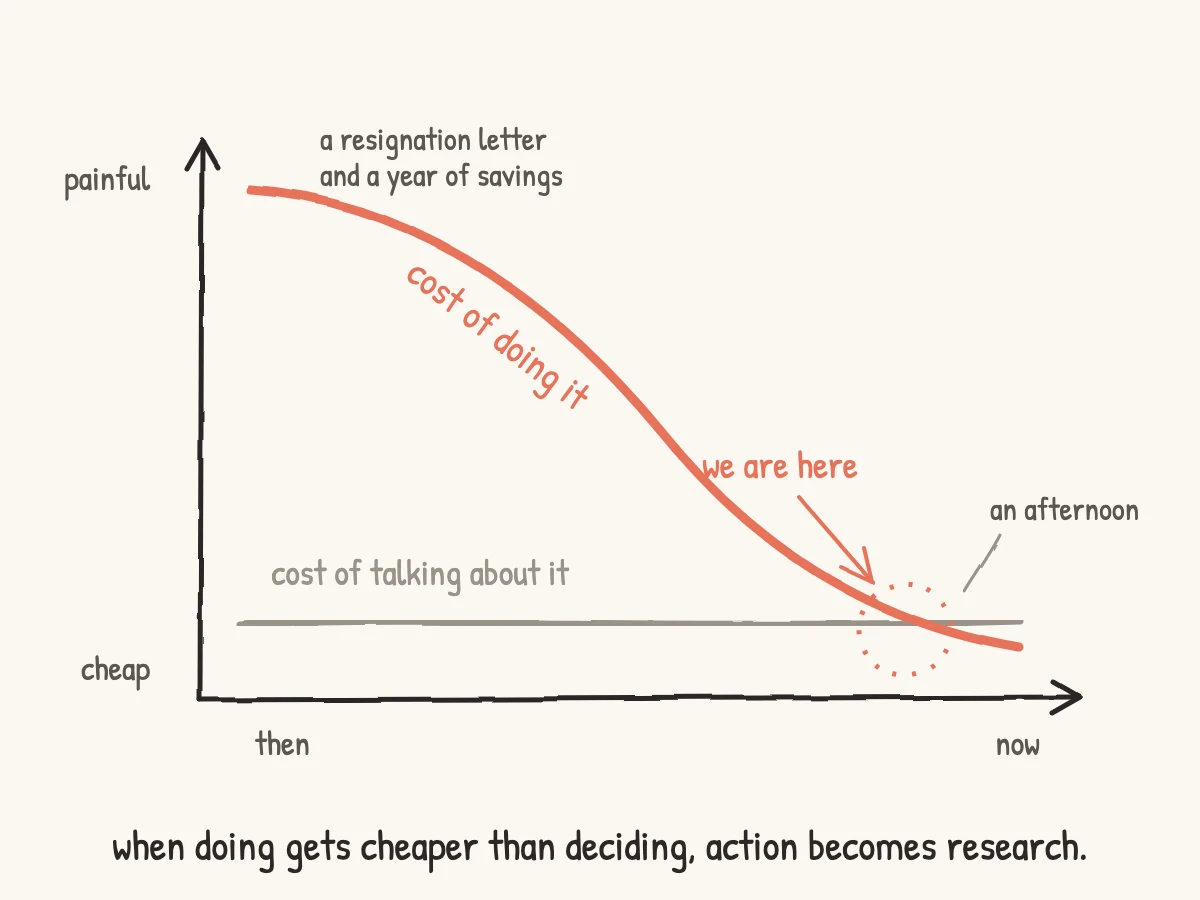
I wrote before that building is thinking. This feels like the same swap, one level up. Back then I noticed the loop inside a single project had reversed: artifact first, understanding second. This is the career-sized version. The cost of doing things, offers, prototypes, content, proposals, is collapsing much faster than the cost of thinking about them. When doing gets almost as cheap as discussing, action itself becomes a research method.
I don't know yet where the limit is. Some decisions still deserve the chair, the irreversible ones especially. Still working out where that boundary sits. But the ratio has moved, and I don't think it's moving back.