
How to Choose an AI Training Provider in Malaysia: 7 Questions HR Should Ask
Short answer: choose the AI training provider that can tell you, before the session, which three to five tasks your team will do differently afterwards, what each participant will build in the room, and how you will check it 30 days later. Course titles, tool lists and trainer bios are easy to compare. They predict very little about what happens on Monday.
This guide is for HR and L&D teams in Malaysia who have been asked to "get the team trained on AI" and are now looking at three quotes that read almost the same.
Why are AI training quotes so hard to compare?
Most training is bought by course title. Pick the topic, compare fees, check the trainer, book the date. That works for first aid or Excel training, where the skill is the same in every company.
AI does not work that way, because the useful skill is specific to your company. "Use ChatGPT to summarise a report" means nothing until it is your report, in your template, with your approval rules. Two teams can sit through the same ChatGPT course. One is using it on the monthly management report by Friday. The other remembers a few good prompts and is back to the old way on Monday.
The gap between those two teams is decided before anyone walks into the room. It comes down to whether the provider asked what the participants actually do all day, and built the exercises from the answer.
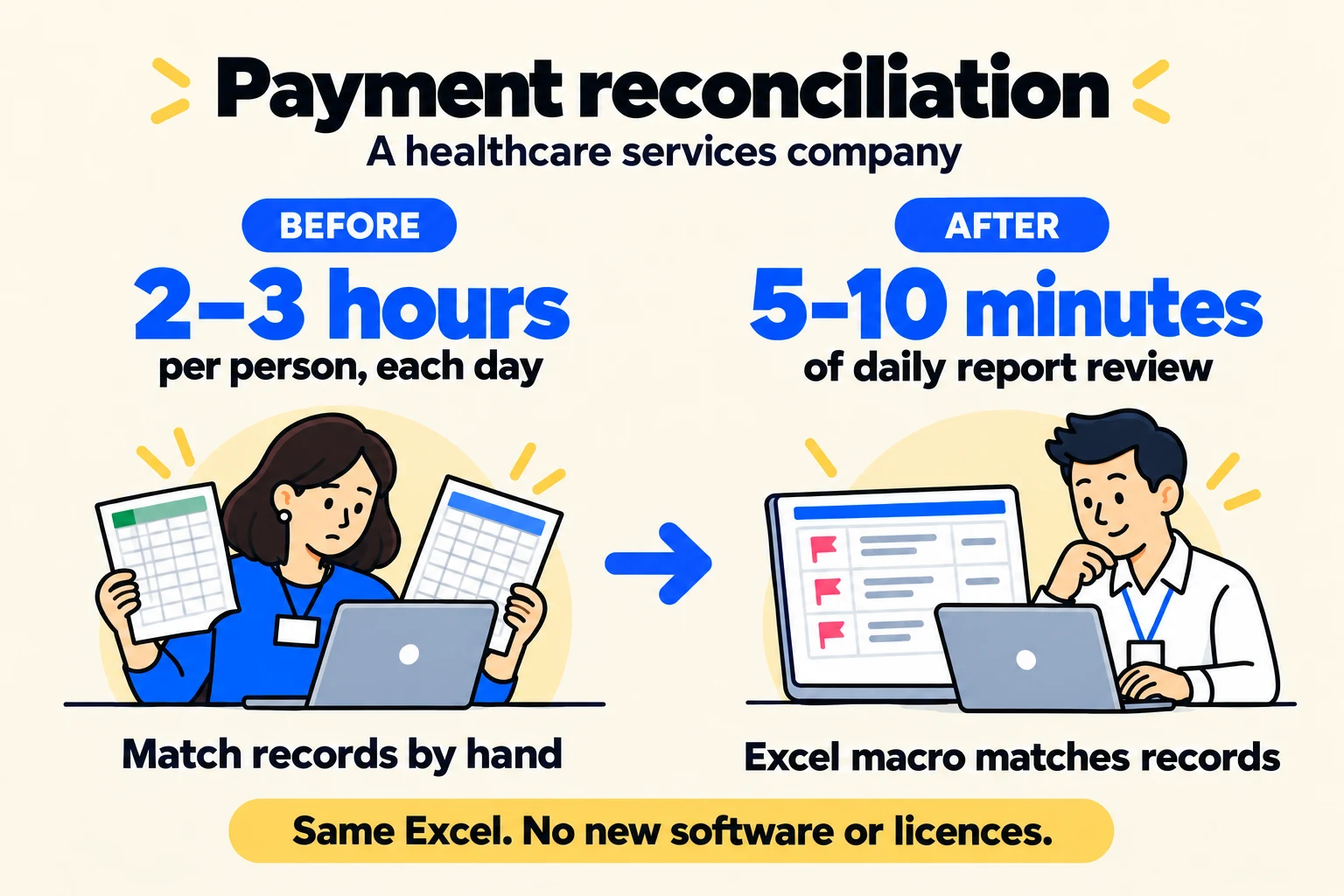
Here is what that looks like. At a one-day programme for a healthcare services company, one participant brought a task three people in the team did every day: matching payment records from one system against reports from another, by hand, in Excel. It took each of them two to three hours a day.
In the session we built the replacement together. AI wrote an Excel macro that does the matching and produces a clean report with the mismatches flagged, running in the version of Excel already on the team's laptops. No new software, no new licences. The task is now five to ten minutes a day, spent reviewing that report instead of building it.
Nothing in that result came from the course outline. It came from asking what the room actually does every day, and then building on the tools they already had.
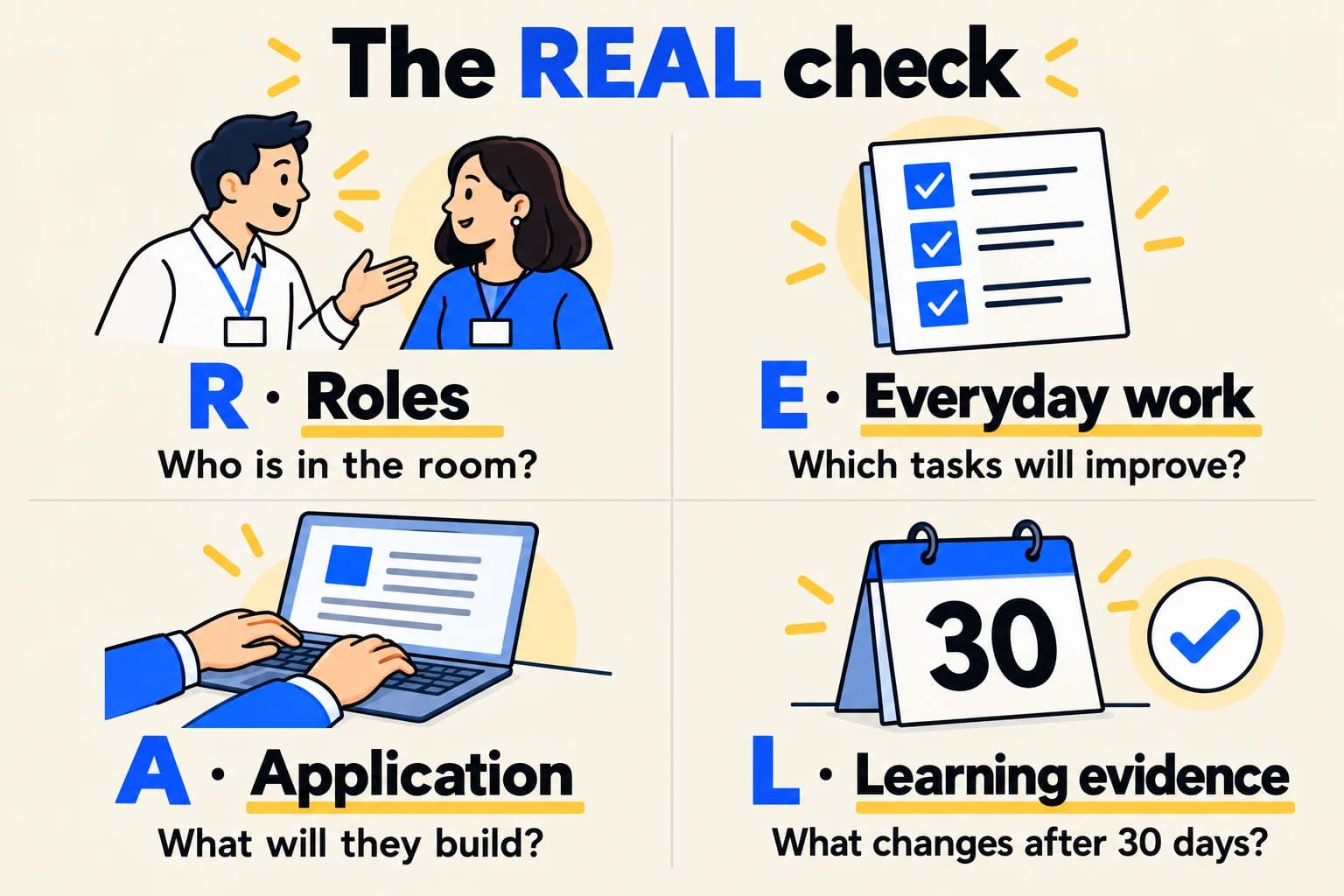
The REAL check: four questions about the programme
Use this as a scoring sheet when you compare quotes. Ask each provider the same four questions and write down what they say.
| Ask the provider | A good answer sounds like | Red flag | |
|---|---|---|---|
| R Roles | Who is this programme designed for? | They ask for job titles, departments and how many people already use AI before they quote | One outline for "all staff" |
| E Everyday work | Which of our tasks will improve? | They ask for your list of recurring tasks and name the three to five the exercises will use | A list of 20 features to cover |
| A Application | What will each participant build during the session? | A named output per person: a reporting template, a prompt set for their role, a working automation they can rerun | "Live demos", "case studies", "Prompt techniques" and "AI tools" |
| L Learning evidence | How will we know it worked? | A check you can run 30 days later: is the template still in use, how long does the task take now | A satisfaction survey and a certificate |
R: Roles
Start with the people, not the software. An HR executive, a finance analyst and a sales coordinator will all use the same AI tool for different jobs. If the room mixes departments or mixes beginners with daily users, ask how the trainer handles that. A specific answer is a split exercise, paired work, or a separate track for advanced users. "We have a standard outline that works for everyone."
E: Everyday work
Before you request a quote, write down three to five things your participants do every week or every month. Preparing the management report. Cleaning a sales spreadsheet. Drafting client replies. Turning meeting notes into action lists. Send that list to every provider. The ones who use it are the ones worth shortlisting.
A: Application
Watching a trainer do something impressive and doing it yourself are different skills. Ask what each participant walks out with, then ask the follow up that matters: could they rebuild it on their own next month, on a different report? If the answer depends on the trainer being there, the team learned to watch.
L: Learning evidence
Decide what "it worked" means before the session, while you still have leverage. Keep it small enough to check: the daily reconciliation now takes ten minutes of review instead of two to three hours of matching, or five of the eight participants still use the template a month later. A provider who helps you define this upfront expects to be measured. That alone tells you something.
Three more questions: tools, data and HRD Corp
REAL covers the programme. These three cover the logistics that sink programmes after the contract is signed.
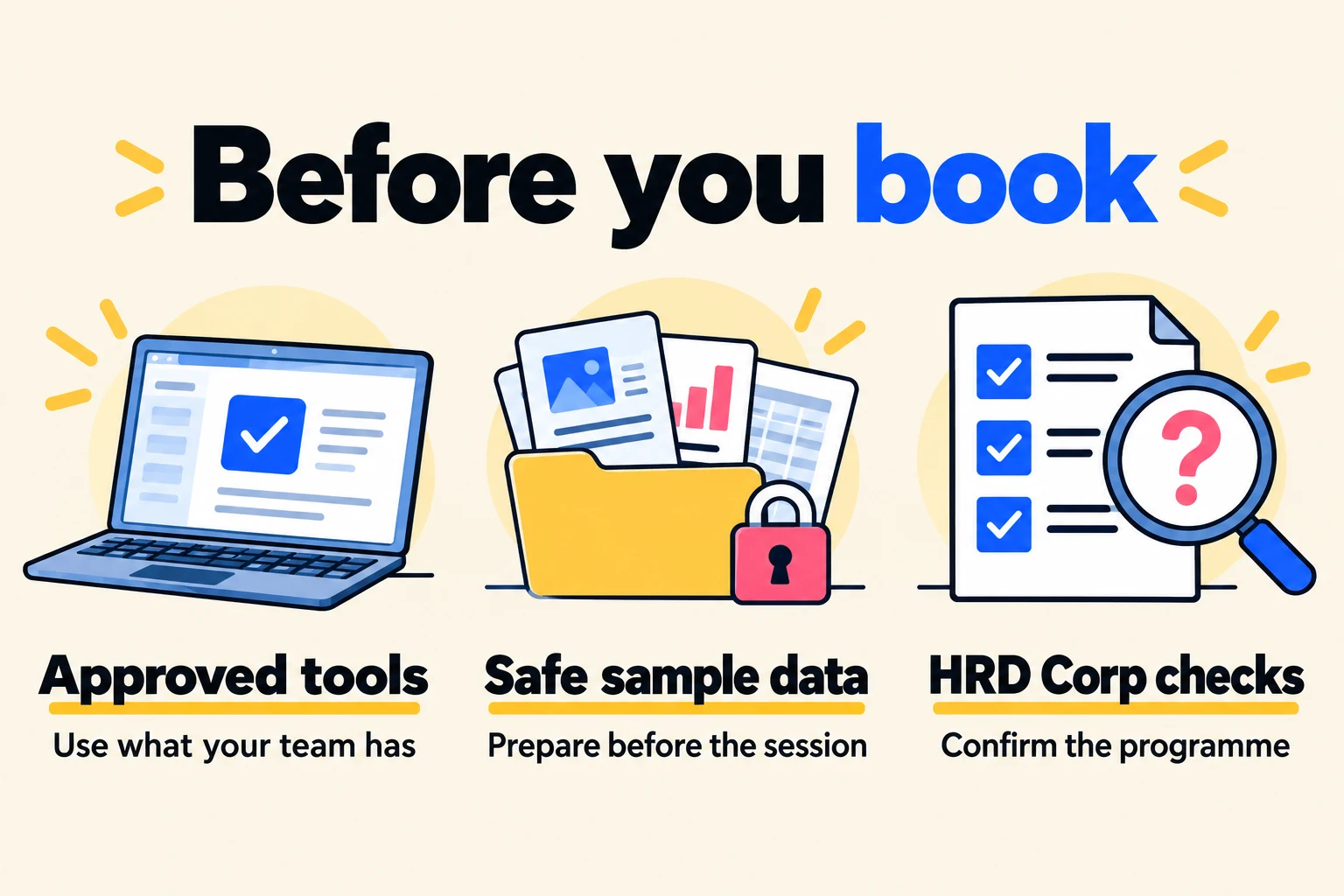
5. Can the exercises run on the AI tools we have already approved? If your company licenses Microsoft 365 Copilot, a course built around ChatGPT leaves staff with two bad options on Monday: a tool they cannot use at work, or a personal account with company data in it. A good provider asks what you have licensed and designs around it.
6. What licences, access and data do participants need on the day? Ask early. IT approvals take longer than booking a trainer. A good answer is a written setup list a week before the session, plus a plan for sample data, so nobody pastes customer or employee records into a public tool. If your team handles personal data, this is a Personal Data Protection Act question as much as a training one.
7. Is this specific programme HRD Corp claimable, and which documents will you provide? Trainer accreditation and programme claimability are separate checks. A trainer can be HRD Corp accredited while a particular programme still needs to meet the claim requirements on its own. A good provider confirms claimability for the programme you are buying and lists the documents you will receive.
Should you choose a standard or a customised AI course?
Choose a standard course when the goal is a shared baseline and the team does not use AI at work yet. Everyone learns the same habits, and that is the point.
Customise when the team already has approved tools, recurring reports, SOPs or a specific problem to solve. Generic exercises waste the day on work nobody does.
The middle option usually works best: a tested core method for prompting, document analysis and handling data safely, followed by exercises built on your department's real tasks using approved sample data. The method stays the same across companies. The exercises change for yours.
Frequently asked questions
Is corporate AI training in Malaysia HRD Corp claimable? It can be, but claimability is confirmed per programme. Ask the provider to confirm it for the exact programme you are booking, in writing, before you commit the budget.
Should we train on ChatGPT, Copilot or Claude? Train on whichever tool your company has approved and licensed. Skills transfer between tools, but habits form on the tool people open every day. If nothing is approved yet, settle that with IT before booking training.
Is online AI training as effective as onsite? Both work when participants have the tools installed and working before the session starts. Online needs a tighter setup check and smaller breakout groups. Onsite makes it easier to help someone whose screen is stuck.
How do we measure whether AI training worked? Pick one task, record how long it takes before training, and check again 30 days after. Add one usage check, such as whether participants still use the template they built. That is enough evidence for a management update.
How much does corporate AI training cost in Malaysia? Fees vary with group size, customisation and duration. Groove publishes its programme fees on the training page so you can compare before you call anyone.
How Groove runs AI training
Our programmes are designed and led by trainers who understand both the learner’s journey and the business processes behind their work. Every participant builds something on their own work during the session, using approved sample data, and leaves with a method they can reuse without us in the room.
We train on ChatGPT, Claude, Microsoft 365 Copilot and n8n workflow automation, and deliver onsite or online.
The reconciliation macro above is the standard we hold every programme to: one real task, the tools you already pay for, and a time saving you can measure the following week.
Comparing AI training providers right now? Send us your team size, the AI tools you have approved and three tasks you want to improve. We will reply with a course outline built around them, so you can score it against the REAL check above.